
Existentialism and Death
In “Existentialism,” death allows the person selfawareness and makes him alone responsible for his acts. Prior to Existential thought death did not have essentially individual significance; its significance was cosmic. Death had a function for which history or the cosmos had final responsibility.
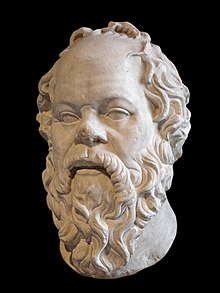
Ancient Greek Philosopher: Socrates
The philosopher Socrates remains, as he was in his lifetime (469–399 B.C.E.),[1] an enigma, an inscrutable individual who, despite having written nothing, is considered one of the handful of philosophers who forever changed how philosophy itself was to be conceived. All our information about him is second-hand and most of it vigorously disputed, but his trial and death at the hands of the Athenian democracy is nevertheless the founding myth of the academic discipline of philosophy, and his influence has been felt far beyond philosophy itself, and in every age.
Socrates’ Views on Death
Socrates insisted that for a true philosopher the day of death was a good one, that because he had lived his life in a good way, he had no fear of death. His friends Crito, Cebes and Phaedo were less convinced and asked him why this might be. Socrates insisted that for a moral person, death was a good thing and should be welcomed. Suicide was wrong, he added, because men and women are the property of the immortal gods, and as such should not be harmed intentionally because this was an attack on the property of others. But when death did come, it was no bad thing. Cebes asked why this might be. Socrates replied that it was because of the immortality of the soul that death was no evil. The purpose of philosophy was to free the soul by guiding it to the eternal truths, and so when death came, it was a liberation. The body, he asserted, was a messy pit of passions and rude cravings. The soul, rather than the flesh alone, was capable of seeing truth, and therefore death was the moment when the soul would be set free to find true virtue and happiness.
–
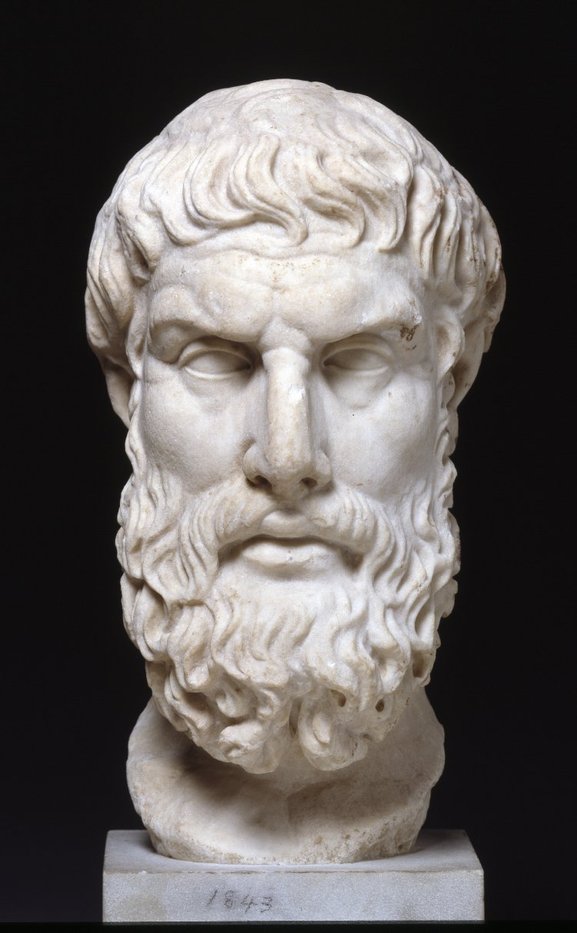
Ancient Greek Philosopher: Epicurus
The philosophy of Epicurus (341–270 B.C.E.) was a complete and interdependent system, involving a view of the goal of human life (happiness, resulting from absence of physical pain and mental disturbance), an empiricist theory of knowledge (sensations, together with the perception of pleasure and pain, are infallible criteria), a description of nature based on atomistic materialism, and a naturalistic account of evolution, from the formation of the world to the emergence of human societies.
Epicurus’ Views on Death
Epicurus believed that, on the basis of a radical materialism which dispensed with transcendent entities such as the Platonic Ideas or Forms, he could disprove the possibility of the soul’s survival after death, and hence the prospect of punishment in the afterlife. He regarded the unacknowledged fear of death and punishment as the primary cause of anxiety among human beings, and anxiety in turn as the source of extreme and irrational desires. The elimination of the fears and corresponding desires would leave people free to pursue the pleasures, both physical and mental, to which they are naturally drawn, and to enjoy the peace of mind that is consequent upon their regularly expected and achieved satisfaction. It remained to explain how irrational fears arose in the first place: hence the importance of an account of social evolution. Epicurus was aware that deeply ingrained habits of thought are not easily corrected, and thus he proposed various exercises to assist the novice
Death, Epicurus argued, cannot touch us because “while we exist death is not present, and when death is present we no longer exist.” Since death cannot touch us it cannot be bad. Fear is rational only for something bad. So Epicurus concludes that fearing death is pointless.
–
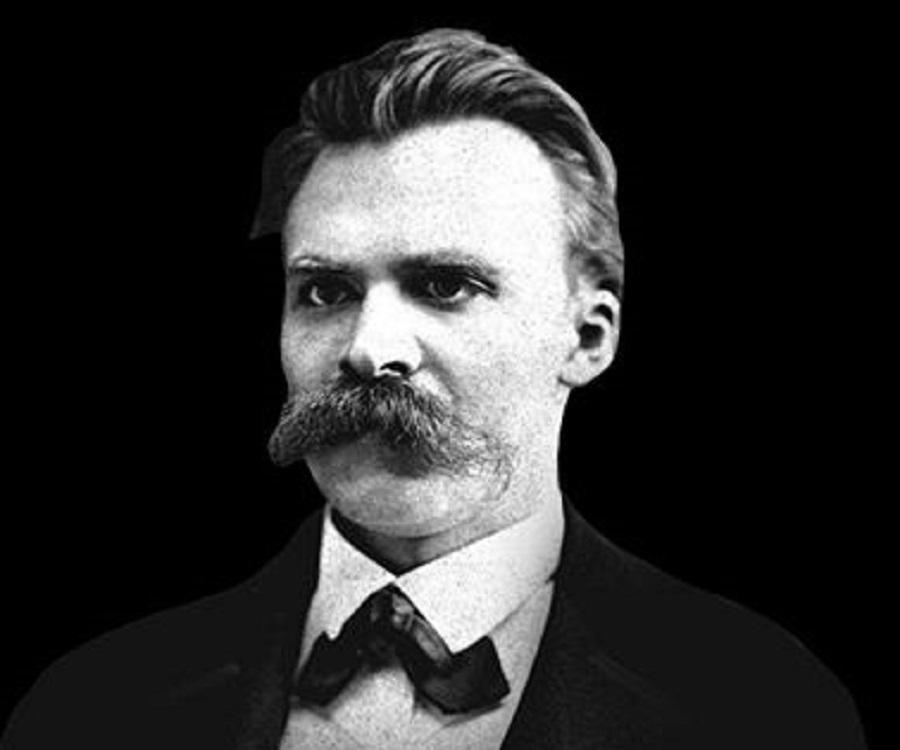
Friedrich Nietzsche
Friedrich Nietzsche (1844–1900) was a German philosopher and cultural critic who published intensively in the 1870s and 1880s. He is famous for uncompromising criticisms of traditional European morality and religion, as well as of conventional philosophical ideas and social and political pieties associated with modernity. Many of these criticisms rely on psychological diagnoses that expose false consciousness infecting people’s received ideas; for that reason, he is often associated with a group of late modern thinkers (including Marx and Freud) who advanced a “hermeneutics of suspicion” against traditional values (see Foucault [1964] 1990, Ricoeur [1965] 1970, Leiter 2004). Nietzsche also used his psychological analyses to support original theories about the nature of the self and provocative proposals suggesting new values that he thought would promote cultural renewal and improve social and psychological life by comparison to life under the traditional values he criticized.
Nietzsche’s Views on Death
Unfortunately, the moralization of our lives has insidiously attached itself to genuine psychological needs—some basic to our condition, others cultivated by the conditions of life under morality—so its corrosive effects cannot simply be removed without further psychological damage. Still worse, the damaging side of morality has implanted itself within us in the form of a genuine self-understanding, making it hard for us to imagine ourselves living any other way. Thus, Nietzsche argues, we are faced with a difficult, long term restoration project in which the most cherished aspects of our way of life must be ruthlessly investigated, dismantled, and then reconstructed in healthier form—all while we continue somehow to sail the ship of our common ethical life on the high seas.
The most extensive development of this Nietzschean critique of morality appears in his late work On the Genealogy of Morality, which consists of three treatises, each devoted to the psychological examination of a central moral idea. In the First Treatise, Nietzsche takes up the idea that moral consciousness consists fundamentally in altruistic concern for others. He begins by observing a striking fact, namely, that this widespread conception of what morality is all about—while entirely commonsensical to us—is not the essence of any possible morality, but a historical innovation.
Nietzsche viewed death, not as a mere event or inevitable termination of life, but as a free act similar to other matters of choice. There are the “living dead,” those who avoid the demands of existence through escape into work and through renunciation of life.
–
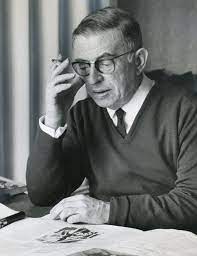
Jean-Paul Sartre
Jean-Paul Charles Aymard Sartre was a French philosopher, playwright, novelist, screenwriter, political activist, biographer, and literary critic. He was one of the key figures in the philosophy of existentialism and phenomenology, and one of the leading figures in 20th-century French philosophy and Marxism.
Sartre (1905–1980) is arguably the best known philosopher of the twentieth century. His indefatigable pursuit of philosophical reflection, literary creativity and, in the second half of his life, active political commitment gained him worldwide renown, if not admiration. He is commonly considered the father of Existentialist philosophy, whose writings set the tone for intellectual life in the decade immediately following the Second World War. Among the many ironies that permeate his life, not the least is the immense popularity of his scandalous public lecture “Existentialism is a Humanism,” delivered to an enthusiastic Parisian crowd October 28, 1945. Though taken as a quasi manifesto for the Existentialist movement, the transcript of this lecture was the only publication that Sartre openly regretted seeing in print.
Sarte’s Views on Death
In his book Being and Nothingness (1956) Sartre established his early phenomenological method, exploring the nature of the human experience. Since Socrates, Western philosophers have suggested that essence or those basic aspects that make up the person are divinely preordained or predesigned prior to birth. Sartre, on the other hand, understood that the person must first exist before that which makes up the person can be identified, as human beings are not objective objects but rather subjective in their dynamic ability to change. Thus for Sartre, existence precedes essence. If analysis starts with the first human experience and ends with the last, then one’s past is the past that was experienced by the individual, the present is the current reality, and the future reflects his or her potential. For Sartre, at the point of death the person does not have a past, as he or she is now dead and cannot continue to write in the log of the present. Rather, a person then becomes his or her past. Like the child who has died, in death the person is frozen in the minds of those persons who remember him or her.
–
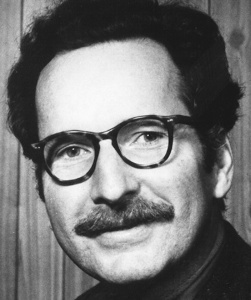
Ernest Becker (The Denial of Death)
“The denial of death” is a phrase from Ernest Becker, and the title of his most famous book, which won the Pulitzer Prize in 1974. Becker’s book focuses on how we human beings develop strategies to fend off awareness of our mortality and vulnerability and to escape into the feeling that we’re immortal. “The practice of dying” is a phrase used by Socrates, as recorded by Plato, for describing one aspect of how a person becomes morally mature. Socrates is urging us to face into our mortality and to let an awareness of death purify our motives.
As a cultural anthropologist, Becker was searching for explanations of why human society develops in the way that it does, and he was particularly interested in why human society is so violent, why different social groups are so intolerant and hateful of each other.
The premise of The Denial of Death is that human civilization is ultimately an elaborate, symbolic defense mechanism against the knowledge of our mortality, which in turn acts as the emotional and intellectual response to our basic survival mechanism.
–
https://plato.stanford.edu/entries/socrates/
https://plato.stanford.edu/entries/epicurus/
https://plato.stanford.edu/entries/nietzsche/#CritReliMora
 Urban Itinerary: Cinematic Space